

From Discovery to Successful Cutover
Introduction
Modern enterprises are rapidly adopting VMware Cloud Foundation (VCF) as the standardized private cloud platform for running traditional and modern applications. Migrating workloads into VCF is not simply copying virtual machines from one environment to another—it is a structured transformation program involving assessment, dependency analysis, migration planning, validation, execution, and optimization.
A successful migration minimizes downtime, eliminates business risk, and ensures workloads are aligned with the target VCF architecture.
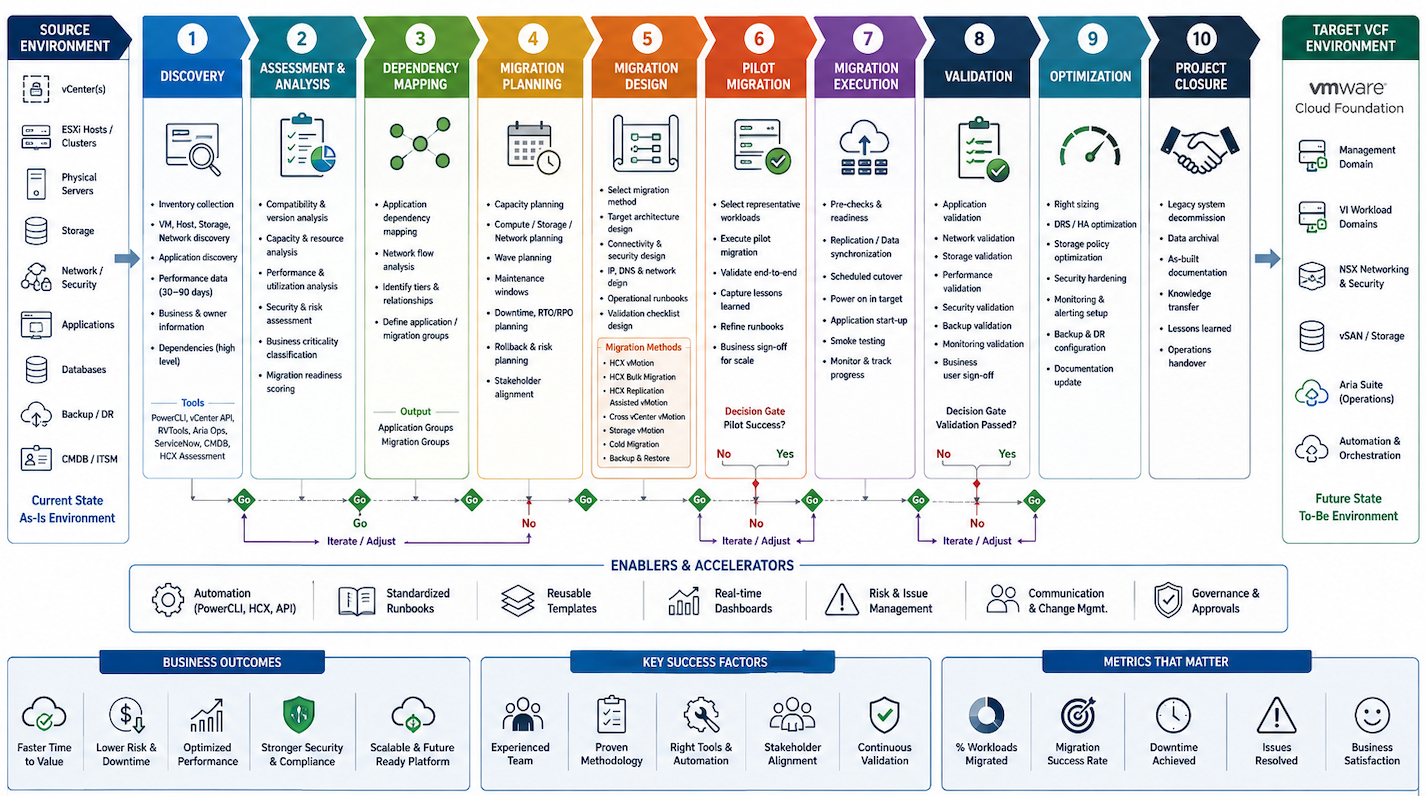
This guide walks through the complete migration lifecycle
1. Discovery – Understanding the Current State
Every successful migration begins with a comprehensive discovery process. This phase focuses on understanding the existing environment by collecting infrastructure inventory, application details, performance metrics, dependencies, and business requirements. The objective is to build a complete picture of the current state and establish a reliable foundation for migration planning.
Key Activities
- Infrastructure and workload inventory
- Application and dependency discovery
- Performance and capacity analysis
- Business and application ownership mapping
- Risk identification
2. Analysis – Turning Data into Insights
Once the environment is discovered, the next step is to analyze the collected data. This includes evaluating workload readiness, identifying technical constraints, assessing compatibility, and grouping applications based on dependencies and business criticality. The outcome is a migration strategy that minimizes risk while maximizing business value.
Key Activities
- Migration readiness assessment
- Compatibility and supportability analysis
- Dependency mapping
- Capacity and performance assessment
- Risk and impact analysis
3. Planning – Building the Migration Roadmap
Planning transforms insights into an actionable migration strategy. This phase defines migration waves, selects migration methods, establishes rollback procedures, aligns stakeholders, and prepares the target platform. Careful planning ensures predictable execution with minimal disruption to business operations.
Key Activities
- Migration wave planning
- Target architecture design
- Capacity and network planning
- Downtime and rollback strategy
- Change management and governance
4. Execution – Delivering a Successful Migration
Execution is where planning becomes reality. Workloads are migrated using the selected migration methodology while validating every stage of the process. Continuous monitoring, testing, and business sign-off ensure applications remain available and perform as expected throughout the migration journey.
Key Activities
- Pre-migration validation
- Data replication and synchronization
- Workload cutover
- Application and infrastructure validation
- Post-migration optimization
The Path to Modern Enterprise Platforms
A disciplined migration methodology enables organizations to reduce risk, accelerate transformation, and build a resilient foundation for future innovation. By following a structured lifecycle of Discovery → Analysis → Planning → Execution, enterprises can confidently modernize their infrastructure, adopt VMware Cloud Foundation, enable Private AI platforms, and accelerate their digital transformation journey.
In future posts, I’ll explore each phase in greater depth, covering best practices, common pitfalls, VMware tools, automation strategies, and real-world migration experiences from large-scale enterprise transformation projects.
Leave a Reply
You must be logged in to post a comment.