

Phase 2 – Assessment & Analysis
The Assessment & Analysis phase is the decision-making engine of every successful migration. After discovering the existing infrastructure, organizations must evaluate technical readiness, application dependencies, infrastructure compatibility, business criticality, and migration risks before defining the migration strategy.
This phase converts raw inventory into actionable insights, enabling enterprises to determine what to migrate, when to migrate, how to migrate, and what risks must be mitigated.
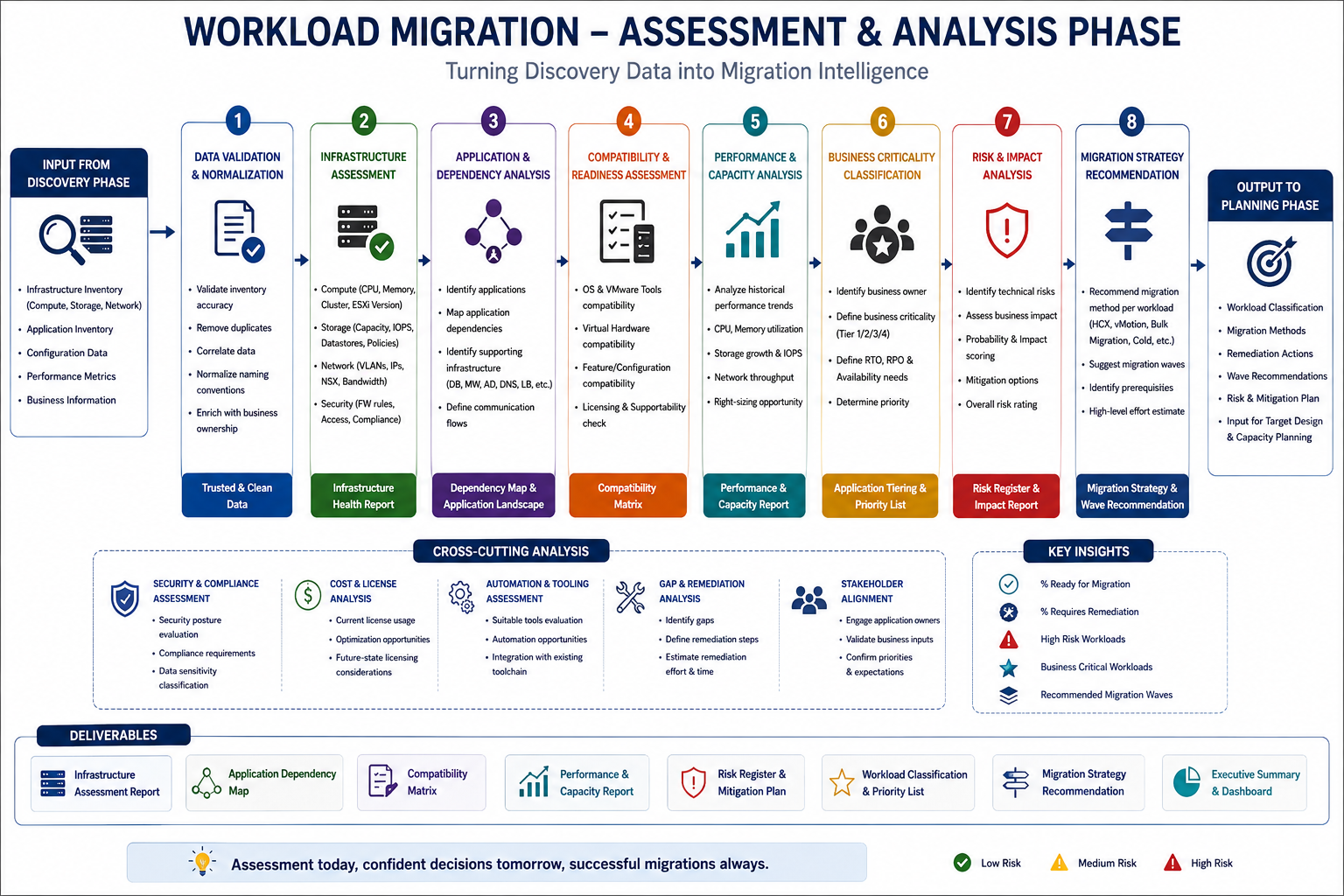
The Assessment & Analysis phase helps organizations:
- Validate discovered inventory
- Assess infrastructure readiness
- Identify application dependencies
- Evaluate migration compatibility
- Analyze resource utilization
- Classify workloads by business criticality
- Recommend migration methods
- Reduce migration risk
Data Validation
Before analysis begins, ensure discovery data is accurate and complete.
Activities
- Validate VM inventory
- Verify application ownership
- Remove duplicate records
- Confirm infrastructure topology
- Validate business metadata
Deliverable: Trusted migration inventory.
Infrastructure Assessment
Evaluate the health and readiness of the existing infrastructure.
Assessment Areas
Compute
- CPU utilization
- Memory utilization
- ESXi versions
- Cluster health
Storage
- Capacity
- IOPS
- Datastore health
- Storage policies
Network
- VLANs
- NSX readiness
- IP utilization
- Firewall dependencies
Deliverable: Infrastructure health report.
Application Dependency Analysis
Applications rarely operate independently.
Understanding dependencies avoids application outages during migration.
Typical dependencies include:
- Database Servers
- Web Servers
- Middleware
- Active Directory
- DNS
- Load Balancers
- Storage Arrays
- External APIs
Dependency mapping enables:
- Correct migration sequencing
- Migration wave planning
- Reduced downtime
- Improved rollback planning
Compatibility Assessment
Determine whether workloads can migrate to VMware Cloud Foundation without modification.
Assessment Criteria
- Guest Operating System
- VMware Tools
- Virtual Hardware Version
- ESXi Compatibility
- Network Compatibility
- Storage Compatibility
- Licensing Requirements
Output
Each workload is classified as:
- Ready
- Requires Remediation
- Requires Modernization
- Not Supported
Performance & Capacity Analysis
Historical performance data ensures workloads receive adequate resources after migration.
Analyze
- CPU Peak Usage
- Memory Consumption
- Storage Growth
- Network Throughput
- Resource Contention
- Seasonal Workloads
This data supports:
- Right-sizing
- Capacity planning
- Resource optimization
- Cost reduction
Business Criticality Assessment
Technical readiness alone does not determine migration priority.
Applications are categorized based on business impact.
| Business Tier | Example | Priority |
|---|---|---|
| Tier 1 | Core Banking, ERP, Healthcare | Highest |
| Tier 2 | CRM, HR Systems | High |
| Tier 3 | Collaboration, File Services | Medium |
| Tier 4 | Development & Test | Low |
Risk Assessment
Every migration introduces technical and operational risks.
Common Risk Categories
- Unsupported operating systems
- Legacy applications
- Capacity constraints
- Network dependencies
- Security gaps
- Compliance requirements
- Business downtime
Risk Rating
| Impact | Probability | Priority |
|---|---|---|
| High | High | Critical |
| High | Medium | High |
| Medium | Medium | Moderate |
| Low | Low | Low |
Migration Method Recommendation
Based on the assessment, recommend the best migration approach.
| Workload Type | Recommended Method |
|---|---|
| Business-Critical | HCX Replication Assisted vMotion |
| Standard Production | HCX Bulk Migration |
| Same vCenter | Cross-vCenter vMotion |
| Storage Refresh | Storage vMotion |
| Legacy Systems | Cold Migration |
Assessment Deliverables
| Deliverable | Purpose |
|---|---|
| Infrastructure Assessment Report | Environment health |
| Dependency Map | Application relationships |
| Compatibility Matrix | Migration readiness |
| Capacity Assessment | Resource planning |
| Risk Register | Risk mitigation |
| Workload Classification | Migration prioritization |
| Migration Recommendation | Preferred migration method |
Executive Dashboard
Assessment Progress
────────────────────────────────────

Infrastructure Assessed      ██████████ 100%

Applications Analysed        █████████░ 95%

Dependencies Mapped          █████████░ 92%

Compatibility Verified       ████████░░ 88%

Capacity Analysed            ██████████ 100%

Risk Assessment              █████████░ 93%

Migration Ready              ████████░░ 90%
Best Practices
Document remediation actions for workloads that are not migration-ready.
Validate discovery data before making migration decisions.
Map application dependencies early to avoid service disruption.
Right-size workloads using actual performance metrics instead of allocated resources.
Prioritize migrations based on business value and technical readiness.
Maintain a centralized assessment dashboard for stakeholders.
Leave a Reply
You must be logged in to post a comment.