

Building the Blueprint for a Successful Migration
Planning determines what, when, and how workloads will move. Migration planning is the bridge between Discovery & Analysis and Execution. It transforms technical findings into an actionable roadmap that minimizes risk, aligns stakeholders, and ensures workloads are migrated efficiently with minimal business disruption.
For large enterprise migrations involving hundreds or thousands of workloads, planning is often the most critical phase. A well-planned migration reduces downtime, avoids unexpected issues, and provides a repeatable framework for executing migration waves.
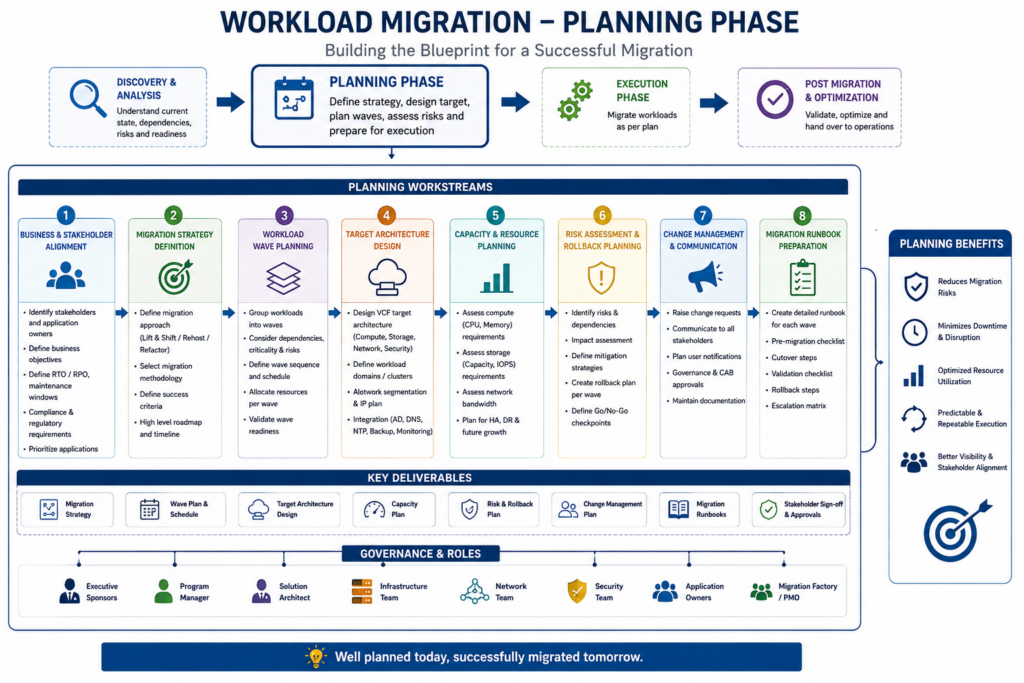
Objectives of the Planning Phase
The primary objectives are to:
- Define the migration strategy.
- Prepare the target VMware Cloud Foundation environment.
- Organize workloads into migration waves.
- Align technical and business stakeholders.
- Minimize downtime and operational risks.
- Ensure every migration has a validated rollback plan.
Business & Technical Alignment
Every migration begins by aligning business priorities with technical requirements.
Business Planning
- Identify application owners and stakeholders.
- Define maintenance windows.
- Establish recovery objectives (RTO/RPO).
- Understand compliance and regulatory requirements.
- Prioritize business-critical applications.
Technical Planning
- Compute and storage capacity
- Network connectivity
- Security policies
- Target VCF workload domains
- Monitoring and backup integration
Deliverable: Approved migration strategy.
Wave Planning Criteria
- Business criticality
- Application dependencies
- Maintenance windows
- Infrastructure readiness
- Risk profile
- Business owner availability
Deliverable: Approved migration wave schedule.
Target Architecture Planning
Design the destination environment before migration begins.
Compute
- ESXi clusters
- Resource pools
- Workload domains
Storage
- vSAN or external storage
- Storage policies
- Capacity allocation
Network
- NSX segments
- VLAN mapping
- IP addressing
- DNS and load balancing
Security
- Firewall rules
- Identity integration
- Micro-segmentation
- Compliance controls
Deliverable: Target VCF architecture.
Capacity Planning
Accurate sizing prevents resource shortages after migration.
Capacity Assessment
- CPU utilization trends
- Memory consumption
- Storage growth
- Network throughput
- Peak utilization
- Future growth projections
Planning should account for:
- Current utilization
- Growth over the next 12–24 months
- High availability overhead
- Disaster recovery requirements
Deliverable: Capacity model.
Migration Method Selection
Choose the best migration approach based on workload characteristics.
| Migration Method | Best For | Downtime |
|---|---|---|
| HCX vMotion | Live migrations | Near Zero |
| HCX Bulk Migration | Large-scale workloads | Low |
| HCX Replication Assisted vMotion | Business-critical systems | Minimal |
| Cross-vCenter vMotion | Same SSO or linked environments | Near Zero |
| Storage vMotion | Storage migrations | None |
| Cold Migration | Legacy or unsupported workloads | Planned |
Selection depends on:
- Application availability requirements
- Network architecture
- Data volume
- Business downtime tolerance
- Compatibility
Risk Assessment & Rollback Planning
Every migration should include a tested rollback strategy.
Risk Categories
- Infrastructure
- Network
- Security
- Storage
- Application
- Business Operations
Rollback Checklist
- Backup validation
- Recovery procedures
- Decision checkpoints
- Go/No-Go criteria
- Escalation matrix
Deliverable: Approved rollback plan.
Change Management
Migration planning extends beyond technology.
Activities
- CAB approval
- Maintenance notifications
- Stakeholder communication
- User awareness
- Documentation updates
- Executive reporting
A structured change management process reduces business disruption and ensures transparency throughout the migration lifecycle.
Migration Runbook Preparation
The migration runbook is the operational guide for execution teams.
Typical sections include:
- Scope
- Roles and responsibilities
- Pre-migration checklist
- Validation steps
- Cutover sequence
- Rollback procedures
- Escalation contacts
- Success criteria
A well-defined runbook improves consistency across migration waves.
Planning Deliverables
| Deliverable | Purpose |
|---|---|
| Migration Strategy | Overall roadmap |
| Wave Plan | Migration sequencing |
| Target Architecture | Future-state design |
| Capacity Plan | Resource sizing |
| Risk Register | Risk identification |
| Rollback Plan | Recovery strategy |
| Change Plan | Governance and communication |
| Migration Runbook | Execution guide |
Best Practices
- Maintain a centralized migration dashboard to track readiness, risks, and progress.
- Build migration waves around applications, not just individual VMs.
- Validate target capacity before scheduling migration windows.
- Use standardized runbooks and checklists for every wave.
- Include rollback testing in planning—not only during execution.
- Engage business stakeholders early to align maintenance windows and expectations.
Leave a Reply
You must be logged in to post a comment.